Can you describe a pivotal moment in your career that significantly shaped your perspective on artificial intelligence and its impact on society, industry, or research?
One of the most defining moments in my career came while working with the Spoken Tutorial, EduPyramids, an initiative developed at IIT Bombay and funded by the Ministry of Education, Government of India. As I interacted with thousands of educators and students across universities, I realized that the greatest challenge was not the lack of technology—it was the lack of accessibility and confidence to use it effectively.
The emergence of generative AI transformed this realization into a mission. I witnessed how a teacher with minimal technical background could design lesson plans, create assessments, generate learning resources, and personalize instruction within minutes using AI. At the same time, I also observed the risks of misinformation, bias, and overdependence on AI-generated content.
This experience reshaped my perspective. I believe Artificial Intelligence should not replace human intelligence; it should amplify human creativity, critical thinking, and problem-solving. Since then, my work has focused on helping educators and institutions adopt AI responsibly, ensuring technology serves as an enabler of inclusive and lifelong learning rather than merely an automation tool.
How do you bridge cutting-edge artificial intelligence research with practical applications to solve real-world challenges and create meaningful impact?
I strongly believe that technology creates value only when it solves real problems. My approach is to translate advanced AI concepts into practical solutions that educators, students, and institutions can implement immediately.
Through workshops, faculty development programmes, and digital skill initiatives, I demonstrate how AI tools can simplify curriculum planning, automate administrative tasks, create personalized learning experiences, generate educational content, and enhance research productivity. Rather than focusing only on theoretical capabilities, I emphasize responsible implementation, measurable outcomes, and ethical usage.
The Spoken Tutorial perfectly complements this vision. While Spoken Tutorial democratizes access to open-source software skills, AI enhances the learning ecosystem by enabling adaptive learning, intelligent content creation, and improved learner engagement. Together, they empower learners with both technical competencies and AI literacy, preparing them for the evolving digital economy.
My objective has always been to bridge the gap between innovation and implementation so that AI benefits not just research laboratories but classrooms, industries, and communities alike.
What is your approach to making critical decisions in artificial intelligence research, development, or implementation, particularly when faced with complex problems, evolving technologies, and ethical considerations?
Every decision I make regarding AI is guided by three fundamental principles: human-centricity, responsibility, and sustainability.
Before adopting any AI solution, I evaluate whether it genuinely improves learning, productivity, or decision-making while maintaining transparency and fairness. Accuracy alone is not sufficient; trust, privacy, accountability, and inclusivity are equally important.
I encourage educators and professionals to treat AI as a collaborative assistant rather than an unquestionable authority. Human expertise must remain at the center of every important decision. This is especially critical in education, where AI-generated information should always be validated through critical thinking and domain knowledge.
In all my AI training programmes—including those integrated with Spoken Tutorial initiatives—I emphasize ethical AI practices, responsible prompting, verification of outputs, and digital citizenship. Technology evolves rapidly, but ethical values should remain constant.
Which emerging discoveries, technologies, or innovations in artificial intelligence excite you the most for shaping the future of science, industry, and everyday life?
Among the many advancements in AI, I am particularly excited about AI-powered personalized learning, multimodal intelligence, AI agents, digital twins, and human-AI collaboration.
Personalized learning has the potential to revolutionize education by adapting content according to individual learning styles and pace. AI agents can automate routine workflows, enabling professionals to focus on creativity and strategic thinking. Multimodal AI is making human-computer interaction more natural by combining text, speech, images, and video into seamless experiences.
I am equally enthusiastic about the integration of AI with open-source technologies. Through initiatives like the Spoken Tutorial, learners can master foundational software skills while simultaneously leveraging AI to innovate, prototype, and solve real-world problems. This combination democratizes innovation by making advanced technologies accessible to every learner, regardless of geographical or economic background.
The future belongs not only to those who use AI but to those who understand it, question it responsibly, and apply it ethically.
What legacy do you hope to leave through your contributions to artificial intelligence, and how would you like your work to inspire the next generation of researchers, innovators, entrepreneurs, and technology professionals?
My aspiration is to be remembered not simply for promoting Artificial Intelligence, but for making it accessible, ethical, and meaningful for every learner and educator.
I envision a future where AI literacy becomes as fundamental as digital literacy, empowering individuals from every background to innovate with confidence. Through the Spoken Tutorial ecosystem, faculty development programmes, and my AI awareness initiatives, I hope to contribute to building a workforce that is skilled in both open-source technologies and responsible AI practices.
If my work inspires educators to embrace innovation, students to become lifelong learners, and researchers to pursue technology with integrity and purpose, I will consider my mission successful.
Ultimately, I want my legacy to be measured not by the number of technologies I introduced, but by the number of lives transformed through education, empowerment, and ethical innovation. I believe the true purpose of Artificial Intelligence is not to make humans less relevant—it is to make human potential limitless.
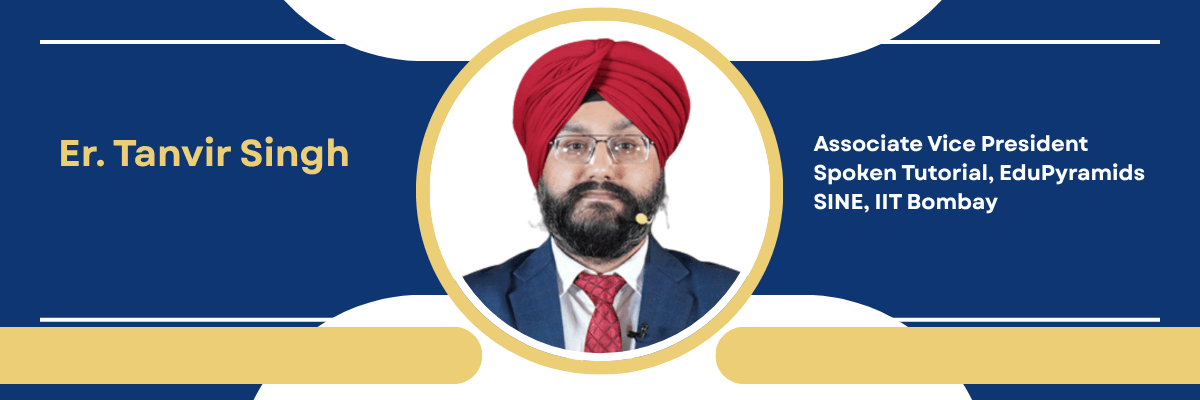
Er. Tanvir Singh
Associate Vice President
Spoken Tutorial, EduPyramids, SINE, IIT Bombay