
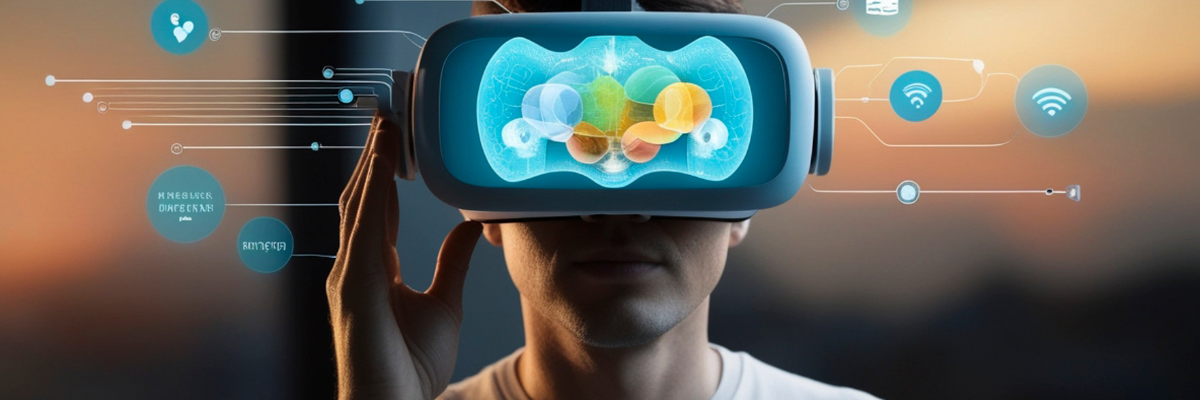
Education has always faced a fundamental challenge: how to make complex ideas meaningful and memorable. For generations, students have relied on textbooks, illustrations, and lectures to understand concepts that cannot be easily observed in everyday life. Whether learning about atoms, ancient civilizations, or distant galaxies, much of education has depended on imagination. Today, virtual reality (VR) is changing that experience. By creating immersive digital environments, VR is enabling students to experience knowledge rather than simply read about it. In doing so, it is transforming abstract learning into something vivid, interactive, and deeply engaging.
From Observation to Experience
Traditional teaching methods often present information through words and images. While these approaches are effective, they can make certain concepts difficult to grasp. Students studying the solar system, for example, may rely on diagrams and videos, but these resources cannot fully capture the scale and movement of celestial bodies.
Virtual reality introduces a different approach. With VR technology, learners can step into simulated environments and interact with information in three dimensions. Instead of reading about historical landmarks, students can virtually walk through them. Rather than memorizing anatomical diagrams, medical students can explore organs and body systems from every angle. Learning becomes an experience rather than a passive activity.
Making Complex Ideas Easier to Understand
Many subjects involve concepts that are invisible, microscopic, or impossible to observe directly. Scientific principles, mathematical structures, and geographical processes often require students to imagine phenomena that are difficult to visualize.
Virtual reality helps bridge this gap by transforming theoretical ideas into interactive experiences. Learners can observe chemical reactions at the molecular level, explore the structure of DNA, or manipulate three-dimensional geometric shapes. In physics, simulations can demonstrate gravity, motion, and energy in ways that traditional diagrams cannot.
By presenting information in a more concrete form, VR makes complicated subjects easier to understand and remember.
Increasing Student Engagement
Keeping students interested and focused is one of the greatest challenges in education. Passive learning methods may sometimes fail to sustain attention, particularly among younger learners. Immersive technologies offer a more engaging alternative.
Virtual reality encourages active participation. Students become explorers rather than spectators, interacting with environments and discovering information through experience. This sense of involvement stimulates curiosity and enhances motivation.
Research suggests that experiences associated with emotions and active participation are more likely to be retained in long-term memory. As a result, immersive learning can improve comprehension while making education more enjoyable.
Applications Across Different Fields
The use of virtual reality extends far beyond science and technology. In history classes, students can visit ancient cities and witness important events through digital recreations. Geography lessons can transport learners to mountains, oceans, and ecosystems that would otherwise be inaccessible.
Medical education benefits from realistic simulations that allow students to practice procedures without risk to patients. Engineering and architecture students can visualize designs before construction begins. Language learners can practice communication in culturally authentic virtual settings.
Even artistic disciplines are adopting immersive technologies to encourage creativity and provide new forms of expression. The versatility of VR makes it a valuable tool across diverse areas of study.
Promoting Accessibility and Inclusion
Virtual reality also has the potential to make education more accessible. Students in remote locations may experience museums, laboratories, and historical sites without traveling long distances. Shared virtual classrooms can connect learners from different regions and cultures.
Furthermore, immersive technologies can accommodate different learning preferences by providing visual, auditory, and interactive experiences. This flexibility supports diverse learners and contributes to a more inclusive educational environment.
As devices become more affordable and widely available, VR could help reduce barriers to quality education.
Challenges and Considerations
Despite its promise, virtual reality faces practical limitations. Equipment costs, internet connectivity, and technical infrastructure remain obstacles in many schools. Prolonged use of headsets may also cause discomfort for some individuals.
More importantly, technology cannot replace the role of teachers. Guidance, mentorship, emotional support, and meaningful discussions remain essential aspects of learning. Virtual reality should therefore be viewed as a complement to traditional education rather than a substitute.
Effective implementation requires thoughtful design and alignment with educational objectives.
Conclusion
Virtual reality is reshaping the learning experience by transforming abstract concepts into interactive and memorable encounters. Through immersive classrooms, students can engage with ideas in ways that were previously unimaginable, making education more dynamic and meaningful.
As the technology continues to evolve, learning may increasingly shift from memorization to exploration. The classroom of the future will not be confined by physical walls or limited by imagination alone. Instead, students will be able to step inside knowledge itself, experiencing ideas in ways that deepen understanding and inspire curiosity. In this new era, education becomes not just something to study, but something to live.