Is there a defining moment in your career that changed the way you see education and interdisciplinary learning? Tell us about it.
My perspective on education was shaped through my work in technology and programme management with organizations like Microsoft, Intel, and Nokia Networks. I realized that while many students had strong academic knowledge, they often lacked communication, collaboration, adaptability, and problem-solving skills.
This convinced me that education should prepare students not just for known answers but for future challenges. At GK Memorial School, we integrated academics, technology, leadership, communication, and life skills, leading to the creation of Launchpad, our Student Readiness Programme. I believe meaningful education lies at the intersection of knowledge, skills, character, and purpose.
How do you draw on multiple disciplines at once to shape learning experiences that spark innovation and tackle real-world problems?
I believe life is interdisciplinary, so learning should be too. Challenges like AI, sustainability, and public health require students to combine scientific thinking, technology, creativity, communication, and ethics.
At GK Memorial School, we promote experiential learning, technology-enabled classrooms, career exposure, and Launchpad to help students connect knowledge with real-world application. Innovation begins by asking not just “What do you know?” but “What can you do with what you know?”
Education constantly shifts, with new needs, new technologies, and different stakeholders to satisfy. How do you navigate that when making important calls in your work?
I evaluate decisions through four lenses: purpose, evidence, people, and sustainability. Every initiative must improve student learning, be supported by evidence, consider stakeholder perspectives, and create long-term value.
We adopt technology only when it enhances learning, not because it is new. My corporate experience taught me strategy and execution, while education taught me that the best decisions balance data with educational purpose.
Which trends in education, or interdisciplinary approaches, do you think will have the biggest impact on how we teach and learn going forward?
AI will transform education by making information readily available, shifting the focus from memorization to critical thinking, creativity, communication, ethics, and problem-solving.
I believe AI-powered personalized learning, competency-based education, interdisciplinary projects, and experiential learning will shape the future. Teachers will increasingly become mentors and learning designers, while successful schools will combine technology with strong human values.
What do you hope your legacy will be in education and interdisciplinary collaboration, and how do you want it to shape the learners, educators, and researchers who come after you?
I hope my legacy is not the institutions I led but the opportunities they created. At GK Memorial School, we have strengthened academics, technology, teacher development, and student-readiness through initiatives like Launchpad.
I hope our students leave with confidence, curiosity, and the ability to connect knowledge across disciplines. For educators and researchers, I hope my work encourages lifelong learning and meaningful innovation. Above all, I want education to empower young people not just to prepare for the future, but to shape it.
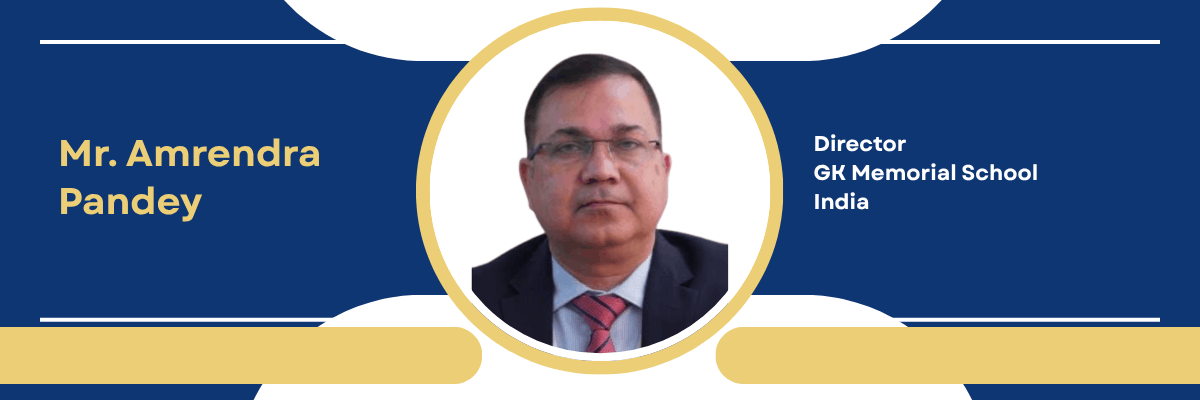
Mr. Amrendra Pandey
Director
GK Memorial School